


Phonics Reform England: Not reading reform. Phonics reform. Improving phonics for the one in five at risk of struggling to read and spell.

Reform 2
-
Reform 1: Early Dyslexia Risk Screening
-
Reform 2: Teacher Understanding of the Self-Teaching Brain
-
Reform 3: Self-Paced Phonics
-
Reform 4: Bidirectional Mapping
-
Reform 5: Technology That Shows the Code
Reform 2 — Teacher Understanding of the Self-Teaching Phase
Research shows that children become independent readers through a self-teaching process (Share, 1995; Ehri, 2005). The purpose of systematic phonics is not to explicitly teach every spelling pattern in English, but to provide the alphabetic knowledge children need to begin teaching themselves through reading.
On this page, we explore the self-teaching hypothesis and its implications for phonics instruction. Understanding how children move from decoding unfamiliar words to recognising them automatically helps explain why the goal of phonics is not programme completion, but giving every child the knowledge and opportunities needed to become a fluent, independent reader.

This is why we ask early years teachers to think of themselves as Bidirectional Word Mapping teachers and self-teaching facilitators, rather than phonics programme deliverers.
It expands their view of the vastness of the alphabetic code and of their crucial role in ensuring that children master it within the literacy-difficulties prevention period: from birth to seven.
The goal is not to explicitly teach every possible spelling choice and sound value. It is to kick-start self-teaching.
That is also why everything used to teach phonics should help teachers check whether children are self-teaching.
One in four children completes a synthetic phonics programme after two or more years and still cannot read and spell securely. They learned only one or two sound values for many graphemes. They did not start self-teaching, and their phonics teachers did not know why. We need to start supporting teachers to understand self-teaching, how to check whether children are transitioning to self-teaching, and what to do when they are not.
We also need to start testing teachers’ bidirectional word-mapping knowledge and providing support where necessary. If teachers are expected to facilitate phonological–orthographic mapping throughout the day and across all year groups, they need to understand how the alphabetic code maps in both directions: from print to speech and from speech to print. It id what the DfE expects, and yet there is no Word Mapping Standard.
Let’s use these quotes as a starting point for discussion.
“The goal isn’t to teach as much about as many properties of print and language as time allows, appropriating more of the school day to get it all done. Rather, it is to enable the child to start acquiring the relevant knowledge as they engage in reading, writing, and spoken language activities.”
(Seidenberg, 2026)
“Explicit instruction is necessary to clue the child in to what there is to learn; they also learn enough basic facts (e.g., about spelling-sound correspondences) to allow new patterns to be assimilated with less reliance on explicit instruction. But the goal is to obviate the need for extensive instruction, freeing the child to focus on reading itself.”
(Seidenberg, 2026)
“The goal of instruction is to get in, get out, and move on: teach enough of the code so that children can begin to learn from other experiences, including their own reading.”
(Seidenberg, 2026)
References
Seidenberg, M. S. (2026). The “Too Much Phonics” Question. Seidenberg Reading.
Seidenberg, M. S. (2026). Recalibrating Phonics and Other Basic Skills Instruction. Seidenberg Reading.


It can be faster instructionally to encourage children to deduce from available cues, because that’s what they’ll eventually do independently when an adult isn’t there.
The instructional part is confirming the word (or simply telling them the word!) and then tracking back:
“OK, so if that’s the word, now map it. What new correspondence did you discover?”
That’s guiding children towards self-teaching, not towards endless explicit instruction of every possible pronunciation alternative.
We also record those discoveries and use a 60-second spelling routine to help store:
• the phonemes
• the graphemes
• the meaning
We even have a stamp for when the word reappears weeks later and the child instantly recognises and uses it. The excitement when you realise it’s now stored in the orthographic lexicon is incredible.




When Policy Claims More Than the Evidence Supports
As The Upstream Team, we are concerned that in England, DfE validated systematic synthetic phonics (SSP) programmes are presented as providing sufficient support for children to become fluent readers.
The Department for Education states:
“A complete programme is one that provides all that is essential to teach SSP to children in the reception and key stage 1 years of mainstream primary schools and provides sufficient support for them to become fluent readers.” (DfE, 2021)
This framing can lead to a reasonable assumption in practice:
If children are taught grapheme–phoneme correspondences, practise decoding, and pass the Phonics Screening Check, they will go on to read successfully.
However, this assumption is not supported by the research evidence, nor by national attainment data at Key Stage 2.
Despite large numbers of children meeting expected standards in phonics at the end of Year 1 (80%) a significant proportion do not go on to achieve reading fluency and comprehension by the end of primary school (25%).
This suggests that learning a set list of 100 or so grapheme-to-phoneme correspondences and decoding within a programme is not, in itself, sufficient to ensure successful reading development.
What the research shows
Research from David Share and Linnea Ehri shows that children become fluent because they begin to learn words independently. Most of reading is acquired via implicit learning.
This happens through a self-teaching process where each attempt at reading a new word can lead to learning, if the child:
-
Generates a plausible pronunciation from the letters
-
Adjusts that attempt when it doesn’t quite match
-
Recognises the word and stores it
Over time, this is how thousands of words are acquired.
Why this matters for teaching
If teachers understand phonics as the whole approach, they may only focus on programme content:
-
Covering the GPCs
-
Securing blended GPCs
-
Moving children through levels
But if their role is understood as enabling self-teaching, the focus shifts. They understand this crucial phase and that at least 1 in 5 will need extra support to achieve it.
Teachers begin to look for signs that children are:
-
Attempting unfamiliar words
-
Producing approximate pronunciations
-
Adjusting their responses
-
Linking sounds and letters across the whole word
These are the behaviours that indicate that learning is happening beneath the surface.
Teachers may begin to use levelled readers that do not align with the taught GPC sequence but offer predictable language patterns, for example:
-
Look at the caterpillar
-
Look at the butterfly
-
Look at the spider
This feature is often absent from decodable readers, as seen in the SSP validation process:
Note 6
The texts and books children are asked to read independently should be fully decodable for them at every stage of the programme. This means they must be composed almost entirely of words made up of GPCs that a child has learned up to that point. The only exceptions should be a small number of common-exception words (see note 2) that the child has learned as part of the programme up to that point. In the early stages, even these should be kept to a minimum. Practising with such decodable texts will help to make sure children experience success and learn to rely on phonic strategies.
However, throughout the day, children encounter texts and writing tasks that do not align with SSP programme content. They need strategies that enable them to tackle words containing grapheme–phoneme correspondences that have not yet been taught, or may never be explicitly taught within SSP programmes. They will never be able to rely on phonics strategies alone to decode everyday words like sugar or Christmas.
Strategies commonly used in classrooms in the past, before synthetic phonics was mandated, worked well for most children in England (4 in 5). What was missing for around one in five was explicit support in connecting sounds to letters once the word was figured out from other clues, including partial decoding.
We know from the Science of Reading that the 4 in 5 children would use cues to identify the word sugar, supported by the picture, and recode it without conscious effort. They are self-teaching. Others will identify the word but do not secure the sound structure or map it to the letters. There is no internal recording.
Understanding this difference changes the focus from whole word v phonics to bidirectional word mapping, and storing the word in the orthographic lexicon. Teachers shift towards observing how children tackle unfamiliar words and step in to support the mapping process where needed, ensuring that recognition leads to learning.
This requires a shift in thinking. Giving a child a word, or supporting them to work it out using context, is not in opposition to phonics. It becomes phonics when the child is guided to connect the sounds in the word to the letters on the page. Phonics becomes a way to secure word mapping, not a rigid system that must be followed with fidelity. Fidelity to a programme ignores the individual needs of each pupil.
In this sense, phonics is not only something that moves from letters to sounds or demands that children only try to decode graphemes from left to right. It can also work from the recognised word back to its sound structure, supporting accurate mapping and long-term learning. We urge the DfE to rethink the Notes and encourage the reading behaviours we see in children who learn to read with no phonics instruction. See Learning to Read Without Phonics Instruction, and expand the concept of phonics to support self-teaching for all. Teachers will need greater autonomy.
We suggest adding decodable levelled readers to phonics sessions that offer repetition so that children begin to predict, while also using the English Code Overlay (ECO) to support at-risk children.
The Key Point
Phonics programmes are intended to provide children with enough knowledge of how letters relate to sounds to begin working out words for themselves. For some children, this is sufficient to support the shift into self-teaching, where they start learning new words independently and move towards reading fluency and comprehension, provided other aspects such as oral language are in place. For others, less input is needed, and too much focus on programme content can actually interfere with their attempts to read and make sense of words. However, for at least one in four children, this shift into self-teaching does not happen securely. These children do not go on to read with fluency and comprehension by the end of primary school, despite being taught through the same approach. Teachers need to understand why this happens and how to assess word mapping.
Saying the sentence “Look at the spider” does not tell us enough about what is happening cognitively. Read on…
Ehri, L. C. (2005). Learning to read words: Theory, findings, and issues. Scientific Studies of Reading, 9(2), 167–188. https://doi.org/10.1207/s1532799xssr0902_4
Ehri, L. C. (2014). Orthographic mapping in the acquisition of sight word reading, spelling memory, and vocabulary learning. Scientific Studies of Reading, 18(1), 5–21. https://doi.org/10.1080/10888438.2013.819356
Share, D. L. (1995). Phonological recoding and self-teaching: Sine qua non of reading acquisition. Cognition, 55(2), 151–218. https://doi.org/10.1016/0010-0277(94)00645-2
Even without systematic phonics instruction, many children will begin to learn to read through self-teaching, because they have sufficient phonemic awareness to work out how letters and sounds connect. These children generate and refine their own attempts, gradually building a bank of known words. What matters is not simply exposure to teaching, but whether the child can use the alphabetic code to recode and secure the full sound structure of words. A child who identifies a word but does not recode it is not building the system needed for ongoing learning. This is where the difference emerges. Children receiving the same teaching can have very different outcomes, and it is those who do not establish this self-teaching process early who are most likely to fall behind by the end of Year 1.
The idea of starting from a recognised word and working back to its sound structure is not made explicit in synthetic phonics teaching guidance, yet it is a valuable self-teaching skill.
Why is this missing?
Recoding sits in a gap:
-
After a word is recognised
-
Before it is securely stored
-
Where the learner needs to analyse and map the full sound structure to the letters
This step is:
-
assumed in theory
-
but rarely taught or named in practice
Why we are not seeing it in classrooms
Most teacher-facing guidance focuses on:
-
decoding (blending graphemes to work out words)
-
encoding (spelling words from speech to print)
But not on:
-
whether to check that when a child figures out a new word if they have mapped it
So teachers may not be prompted to:
-
go back through the word
-
identify each sound
-
link it to the graphemes
-
check for meaning
Speech sounds (phonemes) graphemes and meaning must bond in the brain's word bank, for self-teaching to occur. It happens bidirectionally: print to speech and speech to print.
The Self-Teaching Phase: Why Some Children Learn Words Easily and Others Don’t
Children can't memorise thousands of words, and SSP programmes do not cover every GPC they will ever need to read.
At some point, they have to start working words out for themselves.
We must support children to reach the self-teaching phase, described by David Share and Linnea Ehri.
It is the stage where each new word a child encounters can become a learning opportunity.
But this only happens if the child can actually access the process. For many children not yet experiencing success with reading, the solution may not be more SSP; it may be to teach children to recode, using word mapping technology to support this process. Being shown the code, before or after working with unknown words, is a valuable part of the learning process. They can then decode through the word when it is known.
What happens when a child sees a new word
Research shows what happens in the brain of a child who is not at risk. When they come across a word they haven’t seen before, they don’t decode it perfectly.
They make a best attempt.
They:
-
use what they know about how letters can represent sounds
-
generate a possible pronunciation
-
check whether it matches a word they already know
This is called partial decoding.
The attempt is often not accurate, but it can be close enough to work with.
Set for variability: how children adjust
Children don’t need to get it right first time.
They adjust.
This process, often called set for variability, means the child:
-
Produces an approximate pronunciation
-
Then mentally reshapes it until it matches a known word
For example, a child might say something that isn’t quite right, then recognise the correct word and refine their understanding.
This adjustment is a critical part of how new words are learned.
The role of pictures and context
In real reading, children also use:
-
Sentence context
-
Meaning
-
Pictures
-
Their knowledge of spoken language
These can help them deduce the intended word even when their decoding is not accurate.
So the process often looks like this:
Partial decoding → approximation → context → recognition
The problem: recognition is not the same as learning
This is where things can go wrong.
If a child:
-
Uses context or pictures to guess the word quickly
-
Does not process all the sounds
-
Does not link those sounds to the letters
then the word may be recognised, but not securely stored.
This means:
-
The word may not be recognised next time
-
The child has not learned how the word works
-
Spelling is unlikely to improve
What needs to happen for self-teaching to work
For self-teaching to build a strong reading and spelling system, the child must:
-
Understand the full sound structure of the word (this can mean navigating differing pronunication codes)
-
Link each sound to he letters that are graphemes in the word (this can mean navigating differing pronunication codes)
-
Adjust their attempt when something doesn’t match
-
Confirm the word against their spoken vocabulary
When this happens, the word becomes stored in memory and can be recognised instantly in future, and spelt correctly.
Why many children don’t reach this phase
The self-teaching phase is often described as if it happens naturally.
But for many children, it doesn’t.
If a child:
-
Cannot clearly identify the sounds in words
-
Cannot map those sounds across the whole word
-
Relies on guessing or memorising
then the process breaks down.
Instead of learning from each new word, they remain stuck needing support.
The key point
Self-teaching is not about being exposed to more books. Supporting self-teaching does not mean letting them 'guess' without mapping. It is about whether the child can use the letters to access the sound structure of words well enough to recognise and store them, and we need to better support their entry into this vital phase.
When they can do this, every word they read helps them learn more.
When they can’t, progress slows, and reading and spelling remain difficult. Systematic synthetic phonics programmes have stripped too much from what at least 1 in 5 need from teachers in the early years.
You’ve heard of decoding and encoding, but have you explored recoding, working from the word back to its sound structure?
If they can figure out the word, they can map backwards!
Rethinking “Unreliable Strategies” in Light of Self-Teaching: Recoding as the Missing Link
In the Primary National Strategy (2006), the Searchlights model, also known and three-cueing, was explicitly rejected. Guidance instead emphasised decoding as the primary approach, warning against strategies such as using pictures, rereading, or guessing what might fit:
“…attention should be focused on decoding words rather than the use of unreliable strategies such as looking at the illustrations… or guessing what might ‘fit’… Children who routinely adopt alternative cues… later find themselves stranded when texts become more demanding…” (Primary National Strategy, 2006b, p. 9)
This marked an important shift towards prioritising decoding. However, it did not account for what is now better understood about how children learn words independently.
Research on self-teaching shows that children often generate approximate responses, sometimes described as “intelligent guesses,” when encountering unfamiliar words. These attempts do not, in themselves, hinder learning. In fact, they can support it, provided the child connects the sounds in the word to the letters on the page.
The problem is not that children make approximations. The problem arises when they do not secure the mapping.
If a child identifies a word using context or partial information but does not attend to the full sound structure and link it to the graphemes, the opportunity for learning is lost. However, if the child is supported to analyse and map the word after identifying it, that same attempt becomes a powerful learning event.
This matters because children cannot rely solely on the limited set of grapheme–phoneme correspondences typically taught in early programmes. When they encounter words beyond this taught content, they need to be able to generate, adjust, and confirm their own attempts.
Without this, they are the ones most likely to become “stranded” as texts become more complex.
So while the emphasis on decoding was a necessary correction, it remained incomplete. Decoding does not only move from letters to sounds. It can also work from the recognised word back to its sound structure, if the child is guided to map it. What determines success is not whether a child avoids approximation, but whether they are supported to connect sounds and letters across the whole word.
We are not sure that parents and teachers in England are being shown how to support recoding, starting from the word, yet this is a powerful way to support spelling. When a child recognises or deduces a word, there is an opportunity to work backwards, identifying the sounds within the word and linking each one to the letters on the page. This secures the structure of the word in memory and supports accurate spelling. Without this step, children may recognise words in the moment but not learn how they are constructed, limiting their ability to spell and to learn new words independently.
If phonics is primarily print to speech decoding, treated as sufficient in itself, this discovery process can also be overlooked.
Children may no longer:
-
Read words within a levelled scheme with predictable texts
-
Be encouraged to use context or pictures to identify words
Even without phonics many children learned to read in the past as they were given the opportunity to deduce the words within levelled readers. As long as they had good phonemic awareness they could independently :
-
Process the full sound structure of words
-
Map sounds across the whole word
-
Store words in a way that supports future reading and spelling
In these cases, access to varied reading material supported the activation of the self-teaching process. Through schemes such as The Village With Three Corners, 4 in 5 children learned to read and became avid readers. Rather than throwing them out, and the huge benefits that came with them, for example reading for pleasure, we have created a way for the 1 in 5 to access self-teaching, as we have made the code visible. They do not replace the systematic teaching of the core code and decodable readers that align; they are used alongside this system. We have found that they benefit from doing this when they can segment and blend words with GPCs in Phase 2 Sets 1–5, not because of the GPCs, but because they understand the concept of mapping words.
That is what was missing for the 16% Jim Rose was concerned about in the 2006 Rose Review: “there are particularly urgent concerns nationally about… the 16% of children who do not reach it by the end of Key Stage 2.” Read the Rose Report here
It is now 2026, and two decades later outcomes have worsened, with around 25% of children not achieving this, and reading for pleasure at its lowest levels in two decades (National Literacy Trust, 2023). This is the purpose of Phonics Reform England (PRE).
We appear to have identified a “self-teaching sweet spot” — a transition point where children begin independently applying Set for Variability and implicit orthographic learning.

Visit Reform 6 to learn more!
The Alphabetic Code can only be introduced, not explicitly taught.
Explore the whole code so that you understand that the ‘core code’ is only a kick-start and intended to facilitate self-teaching.
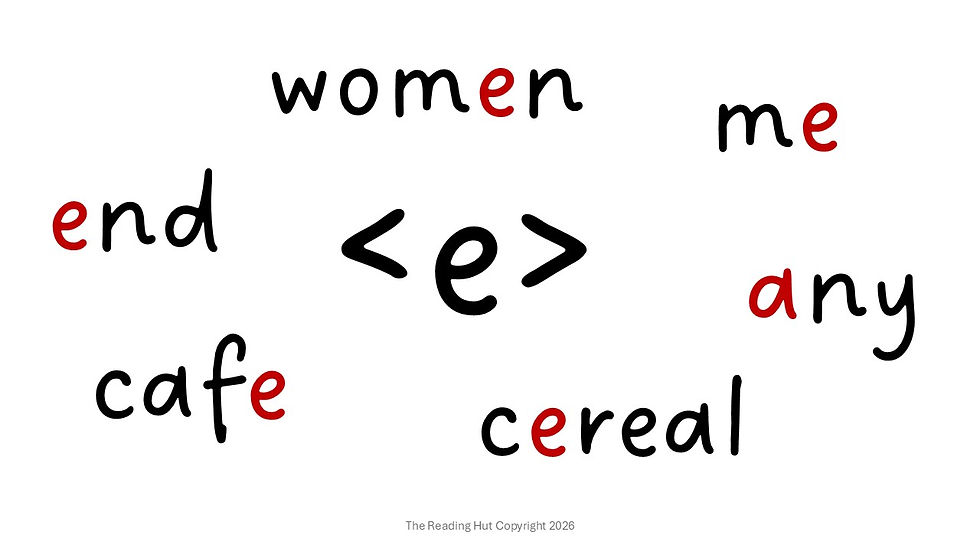
When training teachers to teach word mapping this is one of the activities I do, starting with the sounds of a e i o u
We use Phonemies® to show the sound value. They are ‘Phonetic Symbols for Kids’. They have no link with letters. They simply denote the sound. A dog says ‘woof’. These Speech Sound Monsters each say a phoneme of English.
This means that Avery, aged 4, is able to ‘follow the Monster Sounds to say the word’ (i.e. blend the Monster Sounds) and THEN look at the pictures of the sounds (graphemes) in THAT word.
English has an opaque orthography, so graphemes correspond to many different sounds. These can be seen in resources such as the Spelling Clouds®.
We need to balance explicit teaching of the Core Code, of around 100 commonly used GPCs, with exploration of the whole Alphabetic Code. Teachers must be encouraged to do this. We do it through Word Mapping Mastery®, and so know that it is possible for all children, even at a very young age. There are no quick fixes. Every child needs to start self-teaching as quickly and easily as possible. How we do this really matters.
As oulined in The Conversation by Dr Holly Jospeph “quick fixes” like overlays or fonts don’t address the real issue. They bypass the bonding of speech sounds, spelling and meaning, which is essential for self-teaching and orthographic mapping.
However, we also need to be honest that what’s currently offered isn’t working for a significant number of children. Increasing the “dose” of the same approach doesn’t resolve the underlying problem if children aren’t securing the code in the first place.
What we’re doing is not a shortcut, but it is more efficient. We make the code visible so children can see which letters are graphemes and what sound value they represent, adapting for accent. This supports accurate mapping from the start, rather than leaving children to infer it.
We are mapping the Village With Three Corners series so children can check the code as they explore the books, as and when needed. We consistently see a point where over 90% stop using the cue support and begin self-teaching. We know this because they can make sense of sentences like those in The Chaos poem, not by guessing or relying on vocabulary, but by applying set for variability and working from the code itself.
This is exactly what Phonics Reform England is about. Not replacing phonics, but improving it so that all children can access the full code and reach the self-teaching phase, especially the 1 in 5 who are at risk from the moment they start school. We don’t think teachers are being given the opportunity to try something different. They don’t need to do what we do, but we want the Department for Education to see that change is needed and that phonics programmes are not offering every child the opportunity to become readers. The self-teaching bridge between decoding words with a limited set of GPCs and being able to read The Chaos is not happening for at least 1 in 4, and we don’t support the narrative that this is because they are dyslexic.

Snap and Crack: Cracking Comprehension.
When children are in the self-teaching phase they no longer have to spend so much mental energy figuring out the words, it becomes much easier for them to think about what the words mean. Cognitive load is reduced, so attention can shift from decoding to comprehension, connection, prediction, questioning, and enjoyment.
As teachers, we used to check understanding continuously through interaction, conversation, and observation, without relying on endless formal assessments. The WMM activity Snap and Crack: Cracking Comprehension supports this process by enabling teachers to better understand how a child is processing the text in real time. It also encourages children to ask questions themselves, which is a powerful way to deepen comprehension, develop language, and strengthen engagement with reading.
Use Snap and Crack with Phonics Books and also Levelled Readers