


Phonics Reform England: Not reading reform. Phonics reform. Improving phonics for the one in five at risk of struggling to read and spell.

Passing the Year 1 Phonics Screening Check
Why are 1 in 5 unable to pass the PSC in Year 1?
-
Poor phonemic awareness that has not been secured
-
Difficulty holding and blending sounds in working memory (especially with longer or pseudo-words)
-
Unable to blend phonemes, even when individual grapheme–phoneme correspondences are known
-
Insecure knowledge of the core grapheme–phoneme correspondences assessed (around 95)
-
Confusion when applying known grapheme–phoneme correspondences in unfamiliar contexts (pseudo-words)
-
Inconsistent or unclear modelling of phonemes during teaching
-
Not learning at a pace that is right for them, where learning is achievable but also stretches them. Some children have not even covered the core code when they take the test
-
Unmotivated, particularly when faced with unfamiliar or pseudo-words in the check
What do teachers think of the Phonics Screening Check?
The Phonics Screening Check (PSC) pass mark this year is 31 (usually 32) out of 40, and the cynic in me thinks this is likely because they want improved scores. However, for the first time, I asked teachers on social media to be specific and focus on the 2026 Phonics Screening Check, rather than the concept of the test in general. Read my initial social media post here, and my subsequent thoughts.
Emma Hartnell-Baker
England has spent over a decade mandating systematic synthetic phonics in early reading instruction. The intention was clear: teach children how speech sounds connect to print so they can decode words and become confident readers.
But the outcomes tell a different story.
Around 1 in 5 children still cannot pass the Phonics Screening Check (PSC) after two years of following Department for Education validated programmes. By the end of Key Stage 2, around 1 in 4 children are not reading at the expected level.
At the same time, reading for pleasure among children has fallen to the lowest level in twenty years.
Something is not working as intended.
A child can:
-
recognise graphemes but not blend them
-
blend sounds but not segment them for spelling
-
decode a word in isolation but not store it for later use
All of these children may struggle to become fluent readers
Yet the Phonics Screening Check cannot distinguish between these different profiles.
It produces a single score, but reading development depends on multiple underlying processes, including phonemic awareness, grapheme knowledge, blending, and the formation of stable word representations (Margaret Snowling & Charles Hulme, 2012; Linnea Ehri, 2005, 2014).
This means the check tells us very little about how children are actually mapping words.
If, after two years of instruction, a significant proportion of children cannot demonstrate secure decoding even within this limited scope (Department for Education, 2023), it raises an important question:
Are synthetic phonics programmes meeting the needs of all learners?
These findings are sometimes interpreted as evidence that phonics itself is not effective. This position is reflected in critiques of phonics policy and the Phonics Screening Check by researchers such as Dominic Wyse, Alice Bradbury, and Jeffrey Bowers, who question the validity and impact of systematic, synthetic phonics. However, decoding, and the ability to map speech sounds to graphemes, is well established as foundational to reading and spelling development (Linnea Ehri, 2005, 2014; David Share, 1995). The more plausible interpretation is that current approaches are not securing this mapping for all learners. Rather than abandoning phonics, the issue is how it is understood and enacted in practice within SSP programmes. These findings point to the need to strengthen and refine phonics instruction so that all children can successfully connect speech and print, build stable word representations, and move into independent reading and spelling.

What the Phonics Screening Check Actually Measures
The PSC checks whether children can decode words using roughly 95 grapheme–phoneme correspondences that are explicitly taught in phonics programmes.
This is only a small part of the English writing system. Even in Key Stage 1, children will need to navigate over 300 ways that speech sounds connect to print.
The check was designed to confirm that children have grasped the alphabetic principle, the idea that letters represent speech sounds. Once that principle is understood, phonics should act as a kick-start to self-teaching. Through exposure to print, children begin recognising patterns, applying statistical learning, and building a large orthographic lexicon.
That is the theory.
But for many children, the process breaks down before it even begins.
The Missing Foundation
Many children who struggle with phonics are not struggling because they have not been taught the core GPCs.
They are struggling because of differences relating to the children eg speech sound processing and phonemic awareness, and motivation.
Phonemic awareness is the ability to hear, isolate, and manipulate the individual speech sounds within words. Without this ability, phonics instruction can feel confusing rather than helpful.
Phonics programmes often assume that phonemic awareness will develop naturally because grapheme–phoneme correspondences are introduced. For many children this is true.
For others, it is not.
These children are effectively being asked to connect speech and print before their brains can reliably process the sounds within speech itself.
In simple terms, you cannot hammer a screw and then complain that only the nails connect with the wood.
When Phonics Programmes are More Likely to Work
When children have good phonemic awareness they are able to understand how phonemes connect to graphemes, reading accelerates quickly.
Their brains begin recognising patterns across words. They start identifying correspondences that were never explicitly taught. This process is known as self-teaching.
Once children reach this stage, their reading development becomes largely through implicit learning.
They encounter new words through implicit learning, test hypotheses about how sounds map to letters, and gradually build a rich mental dictionary of spellings and meanings.
This is how fluent reading develops.
Waiting Too Long to Identify the Problem
In England, children are introduced to explicit phonics instruction in Reception and are assessed with the Phonics Screening Check at the end of Year 1.
By this point, the system is already reacting to difficulties rather than preventing them.
Yet speech sound processing differences can often be detected years earlier.
With early screening and appropriate support, many children who would otherwise struggle with phonics can develop the underlying skills they need before reading instruction begins. We are seeking funding to roll out free dyslexia risk screening for all three-year-olds, before they are taught phonics.
When this happens, phonics becomes what it was intended to be: a bridge between speech and print, rather than a barrier.
Why Reform Is Needed
Phonics itself is not the problem.
The problem is how phonics is currently implemented.
Current approaches are not identifying speech sound processing differences early enough. They are not designed to adapt to the pace at which individual children develop phonemic awareness. And they often rely on remedial support after difficulties appear rather than preventing them in the first place.
They are also designed for whole class instruction, as if all learn in the same way and at the same pace. As seen in the DfE programme Letters and Sounds there is a teaching progression set for all children. It is not differentiated or self-paced.
The Department for Education has claimed that current policy “offers sufficient support for all children to become fluent readers”.
The data does not support that claim.
DfE Letters and Sounds (2007)
A key change in recognition of the need to improve synthetic phonics was the removal of the widely used 2007 Letters and Sounds handbook from gov.uk and from the Department’s list of validated phonics programmes.
Letters and Sounds 2007 remained on the Department’s validated list until Spring 2022
However most of the validated programmes were designed around the Letters and Sounds GPC teaching order.
That order is shown below, ,

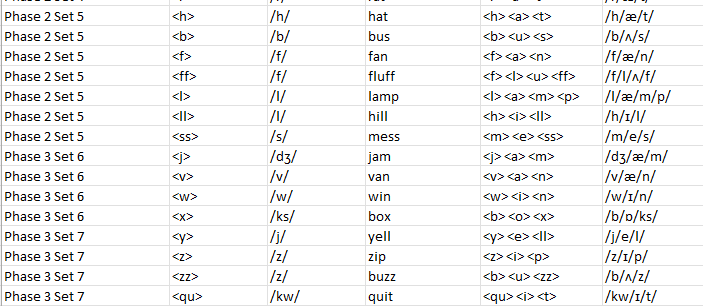
Speech Sound Pics (SSP) Approach Chants : The Grapheme to Phoneme Correspondences Tested in the Phonics Screening Check
Year One "Letter Sounds".
Miss Emma's Phonics Screening Check GPC Learning Suggestions for At Risk Learners


How can we support children who are struggling with phonics and at risk of failing the PSC?
-
Use the Monster Spelling Piano app to secure phonemic awareness and core code knowledge.
-
Use the SSP chants video to:
-
show the grapheme, say the sound, say the sounds in the example word, and blend for them
-
scaffold the blending of phonemes, even when individual grapheme–phoneme correspondences are known
-
ensure secure knowledge of the core grapheme–phoneme correspondences assessed (around 95)
-
provide consistent and accurate modelling of phonemes at home and in the classroom
-
-
The chants enable each child to learn those GPCs at a pace that is right for them, where learning is achievable but also stretches them. We send the SSP chants video home so parents can support this consistently.
-
The consistent nature of SSP chants creates a sense of emotional security for neurodivergent children who do not like change and benefit from routine.
-
Extend this to lots of words to support holding and blending sounds in working memory, especially with longer or pseudo-words. Use them within sentences, and ensure that high-frequency words are also visually mapped.
Why Showing the Sound Value (the P in the GPC) Matters for At-Risk Learners
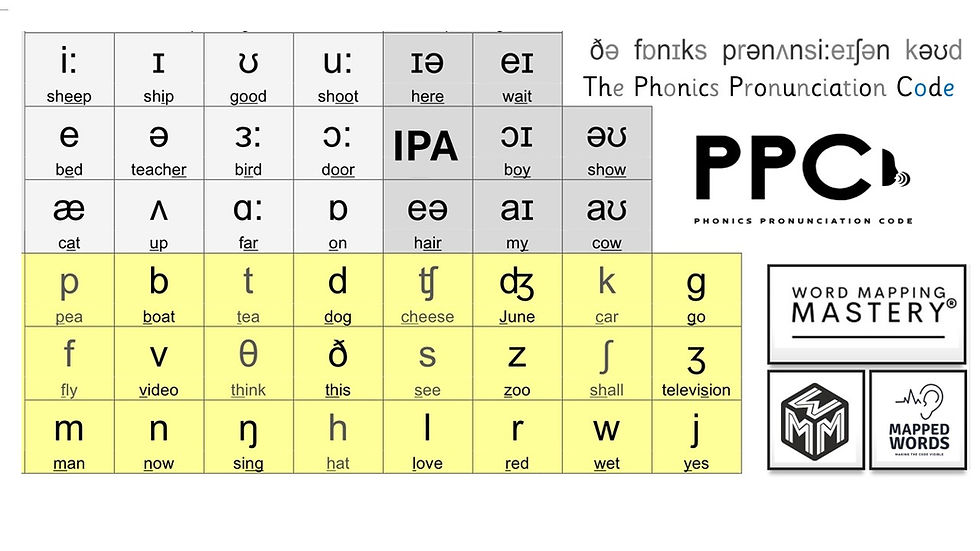
We show the sound value as the Phonemie, alongside the grapheme, which is the visual representation of that speech sound, and a word containing the target grapheme–phoneme correspondence, to make the mapping clear and consistent for the learner. This is important because a grapheme can represent more than one phoneme, and without a clear reference point, this can increase cognitive load and create confusion. By anchoring each grapheme to a known sound through the Phonemie, children can focus on how that sound is functioning in the word, rather than trying to work it out each time. This may seem unfamiliar at first, much like seeing IPA symbols without knowing them, but for the children, the Phonemies are already secure. They learn the sounds quickly, often within one to two weeks, for example through the Speech Sound Play plan, where they spend the first five days segmenting and blending sounds into words before graphemes are introduced. The six sounds that will map to graphemes s a t p i n are the main focus but also their names and other meaningful words. As a result, when graphemes are later added, the connection between speech and print is immediate and meaningful.
They may never be explicitly taught the grapheme–phoneme correspondences that appear in their own names. When they can see the sound value, using Phonemies, which act as accessible alternatives to IPA phonetic symbols, they can instantly understand the connection between grapheme and phoneme. They do not need to wait for that correspondence to be formally taught. The mapping is visible, immediate, and meaningful, allowing them to make sense of the word straight away.
SSP Chants with IPA Aligned Phonemies : The Grapheme to Phoneme Correspondences Tested in the Phonics Screening Check
This is the version to use with at risk children as it shows the sound value with Speech Sound Monsters.