


Phonics Reform England: Not reading reform. Phonics reform. Improving phonics for the one in five at risk of struggling to read and spell.

Rethinking the underlying reasons why some Common Exception Words (CEW) are called 'tricky words'
The phrase “tricky words” reveals more about the programme than it does about the words themselves. It reflects an assumption that the grapheme–phoneme correspondences (GPCs) taught within the programme represent what is “normal” or “common”, and that anything outside this limited set is therefore irregular. In reality, these correspondences are not inherently tricky. They are simply not included, or not yet included, in the programme’s sequence.
In Reception, the pace of introduction is often slow, with children learning a relatively small number of correspondences, often around forty. This creates an artificial divide between words that are labelled decodable and those that are labelled “tricky”. Many high-frequency words fall into this second category, not because of any linguistic complexity, but because the knowledge required to map them has not been made available to the learner.
We have found, across thousands of children in Australia, that chant videos of these words, mapped to show which letters are graphemes, can bypass this, as children can access the learning at their own pace and no direct instruction is required. Teachers in England are told to highlight the part of the word that makes it ‘tricky’, yet when children see the word mapped and hear the sounds, they understand it immediately. No explanation is required. There is less ‘teaching’ and more learning. It is also easy to measure mastery. This constant need to instruct takes considerable time, and many children do not need it. It is a constrained skill, and asking teachers to teach in this way reflects an aspect of the system we are seeking to change. For example, the <ai> in the word said represents the same sound each time it appears in that word. Just show children the word, the mapping, and the sounds.
The Department for Education describes common-exception words as those containing unusual correspondences or correspondences not yet taught, and recommends introducing them gradually while drawing attention to the exceptional part. However, this framing is problematic. Many of these correspondences are not unusual in English. They are frequent and predictable within the wider system, even if they are not prioritised within a particular teaching sequence. Some grapheme–phoneme correspondences that appear in so-called exception words are not taught at all within phonics programmes, meaning that learners are expected to store these words without ever being shown how they work.
Many so-called “common exception words” are only exceptions in certain accents, not in others. Words like past, last, fast, path and bath follow expected sound–spelling patterns for many speakers. The problem arises when a limited mapping is taught as fixed. For example, if a child has only been taught <a> as /æ/ and then encounters grass but pronounces it /grɑːs/, the word is labelled “tricky”. In reality, the word hasn’t changed. The mismatch sits between the teaching and the child’s speech. What is being treated as an exception is often a result of instructional limitation, not a property of the word itself. This is also why we are calling for reform in teacher understanding of the self-teaching brain. When children are shown a word, see it mapped, and actively assign the phonemes while referring to the Phonics Pronunciation Code, the speech–print connection is secured. The word is no longer treated as something to remember or work around. It is understood. When this process is in place, there are no “exception words” for the learner, only words whose structure can be seen, heard and mapped.
This leads to a shift from mapping to memorisation. Instead of analysing the word and securing its sound structure, children are often encouraged to remember it as a visual whole or to focus on a “tricky bit”. This fragments the word and can undermine the development of a coherent orthographic system. It also creates unnecessary cognitive load, as learners are asked to treat some words as fundamentally different from others.
Ironically, the concern about cognitive overload can limit learning further. When children struggle with early phonics, teachers may reduce the number of words introduced, particularly high-frequency words, on the assumption that this will make learning more manageable. Yet if phonemic awareness is secure, the opposite is often true. Learners can approach any new word by identifying the sounds and mapping them to graphemes.
The process is consistent, regardless of whether the word has been pre-taught within a programme.
Starting with the word itself supports this process. The learner says the word, segments the speech sounds, and then maps each sound to its corresponding grapheme. In doing so, they demonstrate both decoding and encoding. The word is not treated as an exception, but as an instance of the same underlying system. This reinforces the alphabetic principle and supports the development of stable orthographic representations.
Crucially, this approach also increases opportunities for application. When words are no longer restricted by programme lists, they can be used more freely in reading and writing activities. Learners encounter them in meaningful contexts, revisit them, and strengthen their representations through use. This repeated, connected exposure is what supports fluency and independence.
Reframing so-called “tricky words” in this way shifts the focus from exception to explanation. It makes clear that the difficulty does not sit within the words themselves, but within the instructional model that withholds or fragments the code. When grapheme–phoneme relationships are made visible and learners are supported to map speech to print, every word can be approached in the same principled way. The label “tricky” is therefore not a linguistic reality, but a reflection of limited instructional scope.
Why are we pushing for this in England?
We’ve already seen how effective this approach can be in Australia.
In many schools, teachers were expected to PM Benchmark their children every term, even in Prep (Reception). This created a clear measure of what children could actually read and use. When children were shown the code and supported to map words, they didn’t just recognise more words, they could also spell them accurately in their writing.
It also led to something more important. Children began to explore grapheme–phoneme patterns for themselves, even when formal phonics instruction was limited. They weren’t waiting to be taught each correspondence. They were using the code.We supported this through the four SSP Code Levels, giving a clear structure while still allowing children to move beyond programme constraints.
The original goal in many settings was for children to recognise and spell around 100 “sight words” before Year 1. In practice, over 90% of children achieved more than four times that number.
This wasn’t the result of more teaching time or increased memorisation. It came from making the code visible and usable.
This small shift had a significant impact on PM Benchmarking outcomes, because children weren’t relying on guessing or recall. They were reading and spelling through secure word mapping.
If you want, I can make this more data-driven or more persuasive depending on your audience.
CEW Mapping with Cue Code
Across thousands of children in Australia, we’ve seen chant videos and mapped 'sight words' bypass the need for heavy instruction. Children learn at their own pace, simply by seeing the word mapped and hearing the sounds. They then demonstrate knowledge of phonemes by using Duck Hands, and know which letters are together as graphemes. Parents and teachers can do this for free. Start in the early years and avoid difficulties.
When children can see the mapping and hear the sounds, they get it straight away. No explanation needed. Less teaching, more learning. And mastery is easy to see. This constant push to instruct takes time that many children don’t need. It’s a constrained skill. For example, the <a> in was and want represents the same sound. Just show the word. Show the mapping. Say the sounds.
Visit https://www.thespellingroutine.com/phonics-england to see and quickly learn the Synthetic Phonics programme 100 High Frequency Word Lists. Parents can use the order shown on the site, which reflects the order that would be provided by their child’s teacher, and then print the words that are relevant to their child, numbering them accordingly.

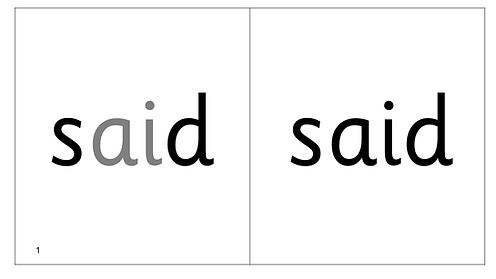
So, if the first HFW is ‘said’, print the card and laminate it, with the mapped word on one side and the regular word on the back, and label it 1 so the child can easily keep them in order for the phonics programme they are following.
Any words can be mapped and downloaded (so that you can change the font and size) using the Innovate UK Funded MyWordz® technology or mapped with the free Lite version of the Code Mapping® Tool as seen here on Speedie Readies®
The DfE stance on these words is:
“Common-exception words are those that include GPCs that are an exception to those children have been taught. They include correspondences that are unusual and those that will be taught later in the programme (such as ‘said’ and ‘me’). Programmes should teach children to read and then spell the most common-exception words, noting the part of a word that makes it an
exception word. These words should be introduced gradually.”
However, this creates a problem. The pace means that as few as 40 might be introduced in Reception. Yet in 2005, Dr Jonathan Solity and his team identified that 100 words make up 53% of the written words in children’s and adults’ reading books.
In other words, children in England are being taught only a fraction of the words they need to access most of what they read, and are being held back from learning them early because decision-makers assume they will not all cope, and worry that teachers will revert to teaching them as whole words to be memorised ‘by sight’, rather than mapped.
These high frequency words come from a database of over 850,000 words.
These 100 words are:
a, about, after, all, am, an, and, are, as, at, away
back, be, because, big, but, by
call, came, can, come, could
did, do, down
for, from
get, go, got
had, has, have, he, her, here, him, his
I, in, into, is, it
last, like, little, live, look
made, make, me, my
new, next, not, now
of, off, old, on, once, one, other, our, out, over
put
saw, said, see, she, so, some
take, that, the, their, them, then, there, they, this, three, time, to, today, too, two
up, us
very
was, we, were, went, what, when, will, with
you
Sixteen of these 100 words make up 25% of all the written words in children's books, and the texts they write:
a, and, he, I, in, is, it, my, of, that, the, then, to, was, went, with
By making the code visible within high frequency words, children can make sense of an opaque orthography providing what each child needs to reach the self-teaching stage.
In the schools we support in Australia, over 90% of children can recognise and correctly spell over 400 high-frequency words before they enter Year 1. They love it! When I tell people that here in England, they cannot see how that is possible. The teaching of these words is often seen as difficult, largely because of phrases such as ‘tricky words’. We aim to support schools in England to change this. It becomes even easier when Phonemies are used, as they further clarify the sound value, but parents and teachers can use the Spelling Routine with or without them.
Show the mapped words, let them hear the sounds and word, and ideally write them as they go. Two minutes a day is all that is needed. You will be amazed at the results. It costs nothing, give it a go.
We also recommend The Spelling Routine.

Choose your HF word order and let them work through it at their pace! Map it and add the audio using the Code Mapping Tool. Children should feel confident recognising and spelling these important words.
Get the word ready: underline the graphemes and make sure you know what it means.
Say the word over the board, where you will write it.
Duck Hand the word from left to right and blend.
Draw Speech Sound Lines, say the sounds, and blend. Duck Hand it.
Draw Speech Sound Numbers, say the sounds, and blend. Duck Hand it.
Write each grapheme on the lines, say the sounds, and blend. Duck Hand it.
Write the word twice, saying the sounds as you write the graphemes.
Get the word ready: underline the graphemes and make sure you know what it means.
Say the word over the board, where you will write it.
Duck Hand the word from left to right and blend.
Draw Speech Sound Lines, say the sounds, and blend. Duck Hand it.
Draw Speech Sound Numbers, say the sounds, and blend. Duck Hand it.
Write each grapheme on the lines, say the sounds, and blend. Duck Hand it.
Write the word twice, saying the sounds as you write the graphemes.
We strongly advise parents and teachers to ignore claims that these words will become decodable later in a programme and instead ensure that children can recognise and spell them all as quickly as possible. Learn more, and download the Letters and Sounds 100 and then 200 words for free at https://www.thespellingroutine.com/letters-and-sounds-tricky-words
This should be taught separately from phonics.
Please do not align these words with GPC learning phases, as seen in the older Letters and Sounds programme.
As many are using the list shown here, we have mapped these words for parents and teachers in England.
Start once children can decode and encode words with s, a, t, p, i, n, as they will then understand that letters are grouped on the page to represent sounds. Although many graphemes contain more than one letter, the shading makes it clear that they are still one unit. This approach can make learning phonics easier.

Phonemies Version- Speech Sound Monsters show the Sound Value