


Phonics Reform England: Not reading reform. Phonics reform. Improving phonics for the one in five at risk of struggling to read and spell.

The Phonics Pronunciation Code
When we ask for the programme PPC (Phonics Pronunciation Code), we are asking for the expected grapheme–phoneme correspondences as they are blended within the word. This makes the phoneme and grapheme arrays visible in context, rather than in isolation. If the word is then said differently, for example due to accent or variation in pronunciation, the phoneme array has changed, and this affects how the graphemes are understood. Each person has their own PPC, which can be different to the programme PPC. The helps teachers and learners n see exactly how speech and print are being connected in that moment. In this context, “array” refers to the full set of graphemes and phonemes in a word. This also makes visible how each a phonics programme represents the print-speech system, including which correspondences are taught and how pronunciation is modelled.
The SSP Programme's Standardised
Phonics Pronunciation Code may differ from the child's
The Phonics Pronunication Code (PPC) can be different to the English Pronunication Code (EPC).
How Phonics Programmes Trigger Letter–Sound Connections
A mnemonic is a simple memory aid, often using a picture, story, or key word, designed to help children remember that letters represent sounds. In phonics programmes visuals, actions, or rhymes link letter shapes (graphemes) to the sounds (phonemes) as prescribed by the Phonics Pronunication Code (PPC) to aid memory. They are used to improve engagement and help children decode words by associating letters with familiar images (e.g., 's' shaped like a snake or 'a' like an appple). These tools are fun and can be highly effective in the early stages, helping children begin to link letters to spoken language. However, it is essential that the child can actually hear and identify the target sound within the example word, rather than just remembering the picture or phrase. The focus must remain on the speech sound itself, so that the connection between sound and print is genuinely understood, not just recalled. Mnemonic phonics is assumed to be an effective way to bridge the gap between abstract letters and concrete, relatable images or actions, but gains can be short-lived. It is easier if the child has good phonemic awareness and used the sounds in their natural speech that does not devicate too far from the PPC.

Regardless of accent they can be useful in supporting letter formation, helping children remember the starting and exit points, and for many, to support recall of an associated phoneme. These are used within Read, Write Inc.
Picture-embedded mnemonics, including systems such as Letterland, are often used to introduce grapheme–phoneme correspondences. A character such as Clever Cat may help a child recall that the grapheme <c> can represent a /k/ sound. As Linnea Ehri notes, this kind of support can be useful in the earliest phase of learning, where children form partial connections and benefit from salient visual cues.
However, this support is transitional, and its limitations become clear very quickly in English. English is an opaque orthography, as seen in the poem The Chaos, where graphemes do not map consistently to a single phoneme. The same grapheme <c> appears in cat and cent, representing different sounds. A mnemonic tied to one sound does not prepare the learner for this shift. The child may remember the character, but not understand the structure of the word. The association must then be overridden or abandoned, creating instability at the point where precision is needed.
This is not a minor issue. Orthographic mapping depends on forming direct, bonded connections between phonemes and graphemes within words. When attention is directed towards characters, stories, or visual prompts rather than the internal structure of the word, this bonding is weakened. The learner may recall the mnemonic but fail to establish a stable representation of the word itself.
The problem lies in where the mnemonic is anchored. Picture-based systems attach meaning to the grapheme, yet in English the instability lies at the grapheme level. A grapheme does not carry a fixed sound value across words, so any system that binds it to a single cue will break down as soon as variability is encountered.
A different approach is to anchor representation at the level of the phoneme. The phoneme remains stable even when its spelling changes. When learners can reliably identify and represent each phoneme in a word, they are better able to map those sounds to the available graphemes without relying on fixed cues or memorised associations. This provides a stable foundation for both reading and spelling in an opaque orthography.

ɛ n i:
Anchor representation at the level of the phoneme with fun Phonemies
(IPA aligned)
There is a Phonemies (Speech Sound Monster) for every sound taught within phonics
The International Phonetic Alphabet (IPA) is a universal system used to represent the sounds of spoken language, with each symbol corresponding to a specific phoneme. This allows speech to be recorded accurately and consistently, regardless of accent or spelling.
When phonetic symbols are used we can also record, or map out, how they are changed by the teacher, or child, as a diagnostic tool.
We believe that everyone involved in teaching or supporting phonics should have a working understanding of the IPA, as it directly relates to how speech is connected to print. To support this, we are developing an on-demand course that can be booked at any time, enabling teachers, teaching assistants, tutors, and parents to build confidence in using the IPA to support accurate word mapping.

This example shows how the word is is being decoded using PPC analysis. The grapheme array <i> <s> is identified, followed by the expected phoneme array /ɪ/ /z/, represented using phonetic symbols. The produced phoneme array is then shown as /ɪ/ /s/, before the final spoken word /ɪz/. In this case, the child, or a teacher being trained in PPC awareness, has recognised the graphemes correctly but produced /s/ for <s>, saying iss (to rhyme with hiss) during blending, before shifting to the correct spoken word is. This reveals a discrepancy between the expected and produced phoneme arrays. Although the correct word is ultimately recognised, the phoneme structure linked to the graphemes has not been securely established. This is important to notice and discuss, as it highlights a mismatch in how the code is being applied and understood.
For children to store words securely, the speech sounds (phonemes), spelling (graphemes), and meaning must bond in the brain’s word bank. If this bonding does not occur, there can be a breakdown in the statistical learning of the alphabetic code. A child may appear successful in the moment, saying the word correctly, but without a secure phoneme–grapheme link, they may later spell it based on how it sounds to them, such as writing iz for is, or woz for was. This shows that accurate word recognition alone is not enough. The underlying structure of the word must be established so that it can be stored and retrieved reliably for both reading and spelling. This is at the heart of the IPA Word Mapping Mastery® system.
The Reading Framework states that:
“Understanding that the letters on the page represent the sounds in spoken words underpins successful word reading. Pupils’ knowledge of the English alphabetic code – how letters or groups of letters represent the sounds of the language – supports their reading and spelling.” (Department for Education, 2023)
The same document further states:
“This guidance explains why teachers themselves also need to understand the alphabetic code: evidence supports the key role of phonic knowledge and skills in early reading and spelling.” (Department for Education, 2023)
We are developing a guide that sets out each programme’s PPC (Phonics Pronunciation Code), showing the expected phonemes for the graphemes that are explicitly taught within that programme.
This makes visible how each Systematic Synthetic Phonics (SSP) programme represents the speech–print system, including which correspondences are taught, how they are organised, and how pronunciation is modelled. Where a ‘letter sounds’ guide is provided by a synthetic phonics programme, we will include it.
This may mean that a programme’s Phonics Pronunciation Code (PPC) deviates from the English Pronunciation Code (EPC). This can change the mapping of some words.
For example, the EPC would show four phonemes for the spoken word queen and four graphemes, as it maps graphemes directly to phonemes where possible, to simplify the mapping process for at-risk children who tend to struggle to isolate phonemes. An SSP programme that teaches qu as a grapheme changes this, so there are four sounds but three graphemes, and children need to combine two sounds within a single grapheme unit.
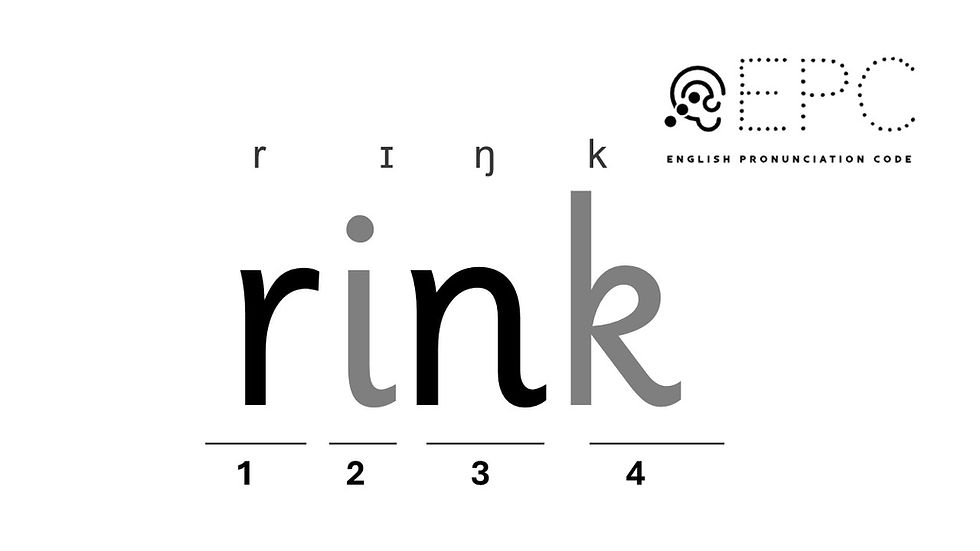
This may also occur with the word rink, which has four phonemes. If a programme chooses to pre-blend graphemes, it changes the mapping. Rather than /r ɪ ŋ k/ mapping to r i n k, children need to understand that n and k have been pre-blended. Although consonant blends were not used within the DfE Letters and Sounds programme, some programmes do pre-blend, and may still do so.
We have found that at-risk children benefit from consistent patterns, and Phonemies® allow for this across programmes. A teaching assistant providing intervention would simply add both /ŋ/ and /k/ Phonemies above or below the nk grapheme used by the SSP programme.
Some programmes also appear to allow for the schwa to be included within graphemes that map to l. For example, mapping the five sounds in p ɛ t ə l as p e t al, rather than p e t a l, and the five sounds in k ɛ t ə l as k e tt le, which reflects that there are only four graphemes.
What matters is that these differences in word mapping are made visible so that all practitioners understand them.
When two sounds map to a single grapheme, this remains consistent across the EPC and PPC. For example, the word unit has five phonemes, /j uː n ɪ t/, and four graphemes, u n i t and the word box has 4 phonemes /b ɒ k s/ and thee graphemes b o x




The alphabetic code refers to the system of correspondences between phonemes in spoken language and graphemes in written English. The Reading Framework notes that “the number of graphemes in a word usually corresponds to the number of phonemes” (Department for Education, 2023, p. 41).
“Phonics is only effective when speech sounds, spelling, and meaning are securely bonded, enabling words to be stored and retrieved for both reading and spelling."
What that means in practice
An individual can:
-
take a word they struggled with
-
map:
-
graphemes
-
expected phonemes
-
what they actually said / thought
-
-
see where it shifted
👉 That’s immediate insight.
👉 and immediate change in how they approach the next word.
With good phonemic awareness the word is stored in the brain word bank (the orthographic lexicon)
Emma Hartnell-Baker MEd SEN
Join us. We are the Upstream Team.

👉 “We analyse words together and learn how the code actually works for each learner”


The Accent Gap in Phonics: Whose Sounds Are We Mapping?
There are simple ways to introduce four-year-olds to the concepts of speech sounds, graphemes, and the idea that their accent may differ from the phonics programme PPC. I show home educating parents and reception teachers how to do this over 10 days, while also screening for dyslexia risk and developing phonemic awareness before introducing a synthetic phonics programme. By day five, children are introduced to graphemes s a t p i n and start decoding and encoding words like ant, tan, pin, nip, sit, Stan, snap etc.
The focus is on making complex ideas accessible, especially for children who do not use Received Pronunciation or who may be at higher risk because of weak phonemic awareness on school entry. As do most early years teachers I use songs, rhymes and stories to support understanding and engagement, and have developed a set of IPA-aligned phonetic symbols for children, called Phonemies. Once the Speech Sound Monsters are introduced, within the Speecch Sound Play Plan, these can be used separate to synthetic phonics to explore word mapping across all grades.
When we launch the community group, we look forward to hearing from others. How do you navigate shifts in the “P” or "G" within GPCs or PGC when decoding and encoding?
Analysing the Code Through Word Mapping
Word mapping with attention to the PPC allows parents, children and teachers to analyse how the code is being applied and use that insight to inform support.
For some children, this may not be necessary, as their brains figure it out. However, for at least 1 in 4, phonics is essential. It is a vital approach designed to systematically connect letters and sounds in a way that enables children to quickly use that mapping in real reading and writing. This is why a group of GPCs is initially introduced, for example s a t p i n.
The Assumption of Fixed GPCs
However, there is an assumption that these GPCs are fixed. Children who learned to read and spell without phonics instruction did not start with parts of words. They started with whole words and worked backwards, bonding letters and sounds in their own accent, even if it varies considerably from the universally accepted phonics pronunciation code, for example a for /æ/ in ant.
Phonics is an attempt to recreate what many children learn to do without it, but in order to do that, it has to be standardised. That is what we see in phonics programmes.
A Bridge Between Phonics and Self-Teaching
My theory is that we can do this and meet the needs of all through a bridge. That bridge is word mapping, using a more analytical approach by identifying the child’s phonemes with the child. In many cases, this results in two separate GPC arrays.
Over time, children begin to do this themselves, as described in Share’s Self-Teaching Hypothesis, but here it is scaffolded.
Supporting Self-Teaching
The goal of word mapping is to support self-teaching. This happens through the act of connecting speech (phonemes), spelling (graphemes) and meaning so that they bond securely.
The Role of the IPA
There needs to be an awareness of a shared reference for the code, such as the IPA, and why it was created. The International Phonetic Alphabet was developed to provide a consistent way of representing speech sounds, so that the same phoneme can be identified and discussed regardless of spelling or accent. I have designed a system that is used in the same way, but that replaces IPA phonetic symbols with Phonemies (Phonemes with an i)
This helps everyone see the grapheme and phoneme correspondences and how allow everyone (regardless of accent) to get to the word in either direction, from speech to print and from print to speech.
The Role of the Speaker
As teachers, we need to consider our own phonemes, especially when modelling. The “P” can shift according to the speaker, which can in turn change the grapheme boundary.
It is far more likely that it is the bond between our own phonemes, graphemes and meaning that supports long-term storage, following an effective kick-start of phonics. We take this kick-start very seriously.
An Under-Explored Area of Research
The issue of how phonemes are assigned and how this interacts with accent is an under-explored area of research that I am currently pursuing.
Emma Hartnell-Baker


