


Phonics Reform England: Not reading reform. Phonics reform. Improving phonics for the one in five at risk of struggling to read and spell.

Show the Code! Print to Speech
When learners decode words they are mapping from print to speech.
In this word he recognises <z> <i> <p>
and blends them.
The single letter graphemes won't always represent those sounds however.
What happens on those occasions?
This is why teachers need to feel confident mapping all words with children, and that they understand the self-teaching phase


Print to Speech Mapping with MyWordz® technology, funded by Innovate UK


How do the letters and sounds connect in the word 'orange'?
You can easily add bidrectional word mapping to your day, in any grade, and explore correspondences you won't explicitly teach in a synthetic phonics lesson. The mapping might change, because of accents! Phonemies® show the sound value here in this reception classroom. Emma Hartnell-Baker has been supporting bi-directional word mapping in Australia for over ten years. How do you show the sound value, without restricting it to one grapheme? eg if you use a ship to show <sg> do you show a ship when mapping 'machine' or 'sugar'


Issues arise not because of 'phonics' or because autistic child can't learn phonics, it is how delivered. Let's make phonics work for ALL brains. Why not Show the Code and fill the phonics programme gaps?
Thank you Innovate UK! You’ve funded word mapping technology that means that children can be shown the code in their time of need.
#ShowTheCode #SpeechSoundMapping #MyWordz #EarlyReading #EdTech #InnovateUK


Can you see the word-mapping errors in this image?
Let's first map the phonemes:
boo = /buː/
zoo = /zuː/
too = /tuː/
food = /fuːd/
moon = /muːn/
room = /ruːm/
tooth = /tuːθ/
spoon = /spuːn/
loop = /luːp/
troop = /truːp/
pool = /puːl/
school = /skuːl/
flute = /fluːt/
cube = /kjuːb/
jute = /dʒuːt/
tube = /tjuːb/
brute = /bruːt/
juvenile = /ˈdʒuːvənaɪl/
include = /ɪnkluːd/
blue = /bluː/
glue = /ɡluː/
clue = /kluː/
true = /truː/
flew = /fluː/
blew = /bluː/
crew = /kruː/
chew = /tʃuː/
drew = /druː/
screw = /skruː/
threw = /θruː/
soup = /suːp/
group = /ɡruːp/
coupon = /kuːpɒn/
wound = /wuːnd/
you = /juː/
goose = /ɡuːs/
music = /mjuːzɪk/
ewe = /juː/
two = /tuː/
As a word mapping nerd, I constantly notice things like this image, posted on LinkedIn, that demonstrate why our work is so important.
At first glance, the chart looks helpful. It groups words by spelling patterns such as <u-e>, <ue>, <ew>, <oo> and <ou>, under the idea of the “long ue sound”. But this is exactly where print-to-speech mapping can create problems.
The first problem is that the chart is not actually grouping one sound.
The “long u” sound is /juː/.
It is the same pronunciation as the word you.
The only examples in the chart actually representing /juː/ are:
-
cube = /kjuːb/
-
tube = /tjuːb/
-
music = /ˈmjuːzɪk/
-
ewe = /juː/
Most of the other examples in the chart represent /uː/, not /juː/.
For example:
-
flute = /fluːt/
-
brute = /bruːt/
-
soup = /suːp/
-
group = /ɡruːp/
-
blue = /bluː/
-
true = /truː/
These are not examples of the “long u” sound. They are examples of /uː/.
Once you run the words through the IPA, the distinction becomes immediately obvious.
That is why using phonetic symbols matters when discussing “sounds”.
The spellings may look similar, but the sounds represented by the grapheme <u-e> in these words are not the same.
For example:
-
flute = /fluːt/
-
cube = /kjuːb/
-
brute = /bruːt/
-
tube = /tjuːb/
These words may all look as though they belong in the same neat spelling category, but they do not all contain the same phoneme structure. Cube and tube include the /j/ sound. Flute and brute do not.
This is not just accent variation. It is not a tiny detail.
If a child is taught that <u-e> represents /uː/ and applies that to cube, they are pushed towards “coob”. They then have to apply set for variability to repair the pronunciation and get back to cube. That is the problem. The mapping was unclear in the first place.
Some children can do that successfully. Others cannot.
Children with weak phonemic awareness, speech and language difficulties, dyslexia risk, or poor orthographic mapping skills often need the spoken structure to be much clearer from the beginning. They need to know what phonemes are actually in the word before they can map the graphemes accurately.
The issue becomes even clearer when we look at words such as sure, cure and pure. Visually, people may want to group these together because of <ure>, but the spoken structures differ. One may include the /j/ sound and another may not. The spelling alone does not tell the whole story.
The word juvenile is another important example here. In the chart, it appears in the <u-e> column, but if the whole word is mapped properly, it cannot really be analysed as containing a split digraph <u-e>. The <e> after <v> maps to the schwa in the following syllable. So the visual pattern is misleading the analysis.
The word goose reveals another problem. It was described as containing the pattern “oo_e”, but there is no split digraph in goose.
The graphemes are:
-
<g> = /ɡ/
-
<oo> = /uː/
-
<se> = /s/
The final <e> belongs to the grapheme <se>. It is not functioning separately to change the sound of <oo> in the way a split digraph supposedly does in words like cube or flute.
That means there is no meaningful “oo_e” unit functioning in the word at all.
I also immediately noticed that the grapheme <o> was missing entirely from the chart, despite it representing /uː/ in words such as do, to and who. That matters too, because once we start grouping words according to visual patterns rather than the actual phoneme-grapheme correspondences, important parts of the code disappear or become distorted.
That is the real problem.
Orthography, what we see, starts driving the analysis instead of the spoken word.
Adults often do not realise this is happening. Strong readers are so used to print that they can be influenced by the spelling without noticing it. They see similar letter patterns and assume the spoken structure must be similar too. That is orthographic interference.
But children learning to read and spell are not starting from expert knowledge. They are trying to connect speech to print. If the adult is not clear about the phonemes in the word, the child is left trying to work out a system that has already been blurred.
For children with strong phonemic awareness and flexible word recognition, these simplifications may not cause obvious problems. They may infer, adjust and move on. For children at risk of dyslexia, children with speech and language difficulties, children with weak phonemic awareness, or children who struggle to map speech to print, these blurred categories can make things harder.
This is why whole-word mapping matters. We have a support group on facebook if this fascinates you too!
https://www.facebook.com/groups/orthographicmapping
We have word-mapping technology that shows which letters function as graphemes and which phonemes they represent across words in English. It helps children, but honestly, it helps teachers just as much. It makes the structure visible. It shows when spellings look similar but represent different spoken structures. It also shows when a word does not fit the category it has been placed in.
Once people understand word mapping, they start to “see” words differently. They stop analysing words as strings of letters and start analysing them as grapheme-phoneme relationships connected to spoken language. That shift reduces confusion for children, especially those already at risk of reading and spelling difficulties.
This is why I pushed back on the chart. Not because teachers should never group words. Not because children need every linguistic term. But because if the adult creating the resource is not clear about the mapping, the resource can unintentionally make English look more confusing than it is.
At-risk children do not need more visual pattern lists that hide the speech structure.
They need the code shown clearly.
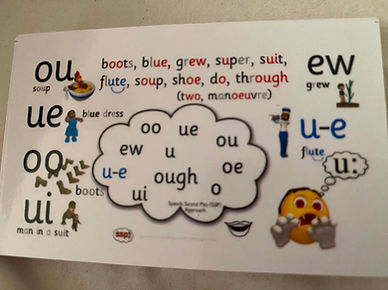
We want every teacher to understand the IPA because it becomes much easier to discuss speech sounds accurately when we can use phonetic symbols rather than vague labels such as “long u sound”.
Using the IPA helps teachers separate the spoken structure of words from the visual spelling patterns. That matters enormously when supporting children learning to map speech to print.
In the image above, the author describes goose as “tricky”. We can only assume this must relate to their own accent, because in many accents the pronunciation is entirely straightforward: /ɡuːs/.
This is another reason why phonetic clarity matters. Without a shared reference point such as the IPA, adults can unknowingly analyse words through the lens of their own spelling habits or accent assumptions, rather than through the actual phonemes being mapped.
We use Phonemies in place of phonetic symbols: phonetic symbols for kids!
The words two and manoeuvre are shown in brackets because, so far, we have only identified these as single examples of that grapheme representing the phoneme. We only add graphemes to the Spelling Clouds® when there are at least two distinct examples in English words.
The mouth image shows that the mouth changes shape as the sound is produced, because the sound itself changes. Listen carefully as you say it and notice how your mouth moves during the pronunciation.
We can show the code with Phonemies® as phonetic symbols. This means we can discuss accent variation

.jpg)

Phonemies show the code not explicitly taught in phonics within the Core Code. For example, the <t> represents a different sound here than in picture or in the word tip.
Children may figure this out through partial decoding and Set for Variability, but it is much easier if they can actually see the mapping.
That’s why we recommend “Show the Code”. And it is so easy for them to learn all the 'Monster Sounds' Many of the childre shown below are using them within the Speech Sound Mapping intervention used to support children with Speech, Language and Communicaion Needs (SLCN)
How are you mapping their names? Do you 'Show the Code'?


Looking at letters and mapping from print to speech can be incredibly difficult for children with SEN or SpLD. Many need a visual representation of the sound value so that the link between letters and sounds is clearer.
A great way to understand how many correspondences are not explicitly taught is to look at The Chaos Poem, or simply map children’s names.
Think carefully about the sound value each grapheme represents.
We are Level 7 SpLD specialists and want to make English orthography easier for ALL
Phonemies are great for developing phonemic awareness pre-phonics!
Over 70% of the names in every classroom have correspondences never taught explicitly in synthetic phonics programmes. Print to speech won't 'work' if they only know the phonics programme correspondences. What then?