


Phonics Reform England: Not reading reform. Phonics reform. Improving phonics for the one in five at risk of struggling to read and spell.
Scripted Phonics
We are analysing all 44 validated Systematic Synthetic Phonics (SSP) programmes because the DfE provides very little information about how they differ. We believe everyone should be able to make informed decisions based on a clear understanding of those differences. We also hope that none of the programmes rely on heavily scripted teaching, where professional judgement is replaced by compliance with a script.

-
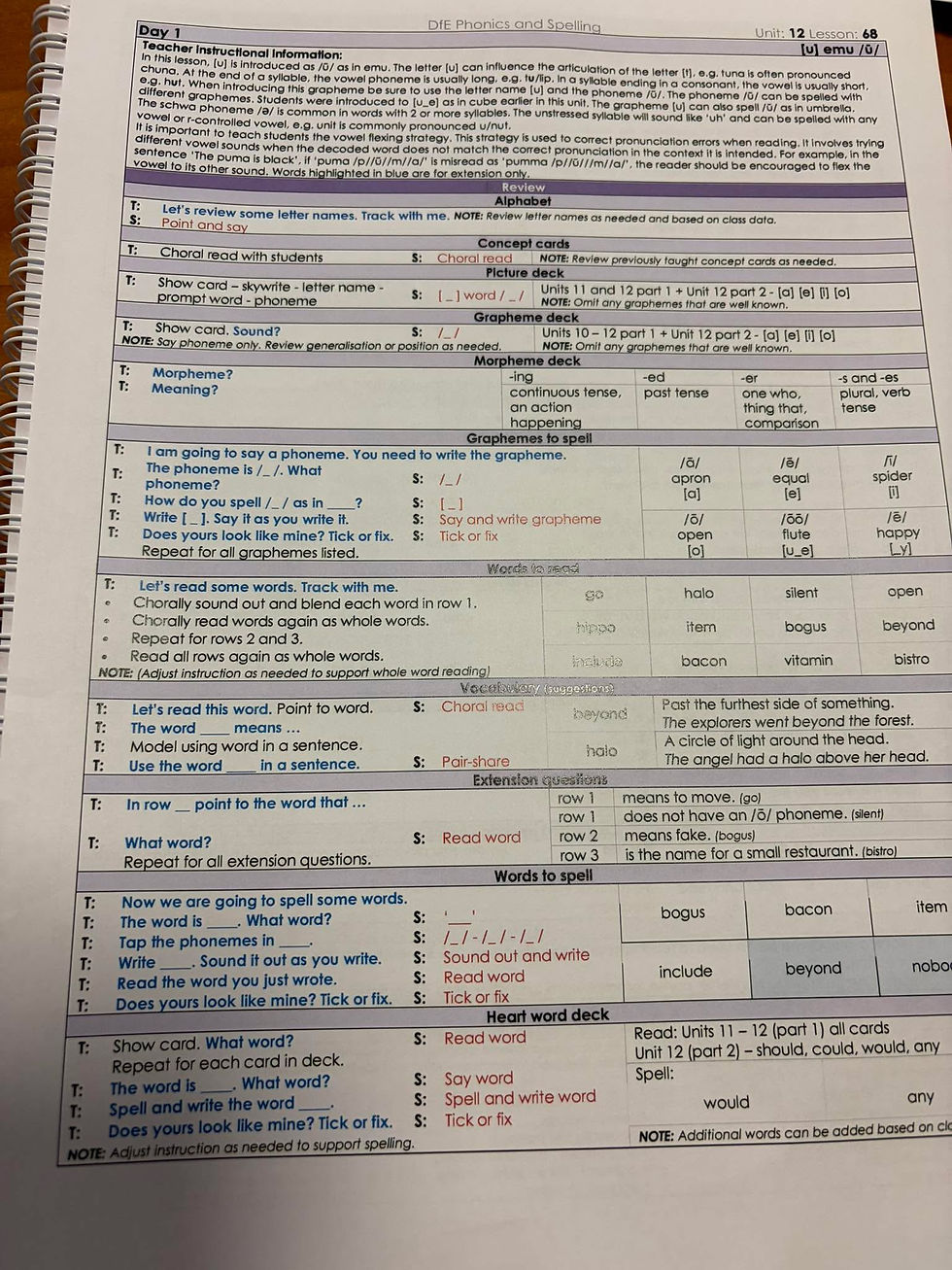
DfE South Australia Phonics and Spelling Unit 12, Lesson 68 [u] emu /ʉː/
"This year our school has started InitiaLit, Ochre slides for maths and scripted Religion lessons. I’m trying really hard to teach with enthusiasm and be excited about reading the scripts but I feel like a robot and my prep students are not engaging very well with me or the lessons. I’ve been teaching for 20 years and I have never felt so flat about my job. Can someone tell me that script based teaching gets better? I’m not sure I can keep doing this."
https://www.facebook.com/groups/australianprimaryteachers/posts/3595092160791658/
Scripted Phonics Lessons: Are We Solving the Wrong Problem?
I understand why scripted phonics lessons appeal to some schools.
School leaders want consistency. They want every child to receive the same high-quality instruction, regardless of which teacher is standing at the front of the class. They worry about varying levels of teacher knowledge, inexperienced staff and relief teachers.
In Australia, programmes influenced by the Direct Instruction tradition, such as Reading Mastery and Spelling Mastery, and programmes developed from that tradition, such as InitiaLit, use heavily scripted lessons designed to achieve that consistency.
The intention is good.
The question is whether scripting is the best solution.
A script is only as good as the knowledge behind it
One assumption behind scripted lessons is that the script is always correct.
In reality, a script is written by people.
Like all teaching and testing materials it reflects the knowledge, assumptions and decisions of its authors.
That means a scripted lesson can contain inaccuracies, oversimplifications or concepts that are introduced before children are ready for them. When that happens, teachers have little room to adapt because fidelity to the programme often becomes more important than professional judgement.
For example, one South Australian Department for Education phonics lesson states that children are learning the grapheme <u> representing the phoneme /ʉː/.
However, within the same lesson children are expected to think about:
-
phonemes
-
graphemes
-
long vowels
-
short vowels
-
syllables
-
open syllables
-
articulation
-
blending
-
segmenting
-
spelling
-
reading
-
vocabulary
-
morphology (-ing, -ed, -er, -s)
That is an enormous amount of cognitive demand for a lesson that is supposedly introducing one new grapheme-phoneme correspondence.
The lesson also includes words such as human, music, tuna and unit, requiring children to think about far more than a single vowel correspondence.
The accompanying teacher notes introduce articulation, pronunciation and syllable-based generalisations alongside the new grapheme.
Whether or not those decisions are appropriate, they demonstrate an important point: even a script requires expert judgement to determine what children are actually being asked to learn.
The child disappears behind the script
A heavily scripted lesson typically follows a sequence such as:
Say this.
Ask this.
Show this card.
Read these words.
Repeat three times.
Tick or fix.
The lesson is built around delivering a sequence rather than responding to the child in front of the teacher.
For many children this may work perfectly well.
For others, particularly those with speech and language needs, developmental language disorder, ADHD, autism, phonological working memory difficulties or those at risk of dyslexia, the pace and cognitive load may quickly become overwhelming.
Professional teachers constantly make decisions.
Should I slow down?
Should I revisit yesterday's learning?
Should I reduce the cognitive load?
Should I explain this differently?
Should I ignore today's lesson and address the misconception I have just noticed?
A script cannot answer those questions.
Why are scripted programmes becoming popular?
From my own experience working with Australian schools, I found two broad reasons.
Some teachers had no choice. They were required to follow a scripted programme regardless of their own professional judgement, and several told me this affected both their confidence and wellbeing.
Others actively welcomed scripted lessons because they lacked confidence in teaching phonics without them. In particular, many lacked confidence in supporting children's understanding beyond the core phonics content and into wider English orthography.
That should concern us.
If teachers feel unable to teach reading without following a script, the solution is not necessarily a better script.
Perhaps the solution is better teacher knowledge. Are we checking teacher knowledge, even around how they map phonemes and graphemes in words? No.
The purpose of phonics
Mark Seidenberg has argued that explicit phonics instruction should enable children to become independent learners of print, not keep them dependent on explicit instruction.
As he explains:
"The goal isn't to teach as much about as many properties of print and language as time allows, appropriating more of the school day to get it all done. Rather, it is to enable the child to start acquiring the relevant knowledge as they engage in reading, writing, and spoken language activities."
(Seidenberg, 2026)
He also writes:
"Explicit instruction is necessary to clue the child in to what there is to learn; they also learn enough basic facts (e.g., about spelling-sound correspondences) to allow new patterns to be assimilated with less reliance on explicit instruction. But the goal is to obviate the need for extensive instruction, freeing the child to focus on reading itself."(Seidenberg, 2026)
The goal is not programme completion.
It is the self-teaching phase.
Children should become increasingly able to acquire new orthographic knowledge through reading itself.
A different question
Rather than asking whether teachers are following the script accurately, perhaps we should ask a different question.
Do teachers understand English orthography well enough to know when the script is wrong, incomplete or unnecessarily complex?
If only a small number of people notice discrepancies within a scripted lesson, that suggests we have a wider issue with teacher knowledge.
That isn't an argument against teachers.
It's an argument for investing in teachers.
The best reading instruction has never been about replacing teacher expertise with a script.
It has been about developing teacher expertise so that professional judgement can be exercised with confidence.
As Seidenberg concludes:
"The goal of instruction is to get in, get out, and move on: teach enough of the code so that children can begin to learn from other experiences, including their own reading."
(Seidenberg, 2026)
That is a very different vision from one in which success is measured by how faithfully a teacher follows a script.
References
Seidenberg, M. S. (2026). The "Too Much Phonics" Question. Seidenberg Reading.
Seidenberg, M. S. (2026). Recalibrating Phonics and Other Basic Skills Instruction. Seidenberg Reading.